From Liberation to Limbo.Trade policy shockwaves are just beginning to reverberate.
Market Update
KEY OBSERVATIONS
Tariff Escalation Raises Recession Risk: U.S. tariffs, despite a temporary pause, have intensified global trade tensions. Without policy offsets, the economic drag increases the likelihood of recession. Markets briefly rallied on tariff delays but remain vulnerable to policy uncertainty.
Economic Placebo: The Bump then Fade – Tariffs could spark a short-term boost as consumers front-load purchases with the expectation of higher future prices. However, as higher costs hit profits and confidence, businesses and consumers may pull back.
Core Market Drivers Still Matter Most: Tariffs have dominated headlines, but they do not dictate the full story. Fundamentals like earnings growth, valuations and bond yields remain key drivers of long-term returns. Should growth falter, the Fed may pivot. And if tariff revenue is redirected into a “big, beautiful bill,” fiscal policy could become more supportive. Tariffs and the shifts in U.S. policy are clearly relevant, but they are not all-encompassing.
RECAP
Liberation, Escalation, Respite, Limbo… The Current State of Things
April opened with a bang, marked by an assertive shift in U.S. trade policy. Even with a 90-day reciprocal tariff pause in place, the U.S. has implemented a 10% universal tariff, renegotiated trade agreements with Canada and Mexico, implemented auto tariffs, and engaged in a trade war with China, the world’s largest export economy.
We could debate the merits or intent of these policies, but the reality is simple: they are here. And without meaningful resolution, monetary or fiscal offsets, their presence increases the probability that the U.S. economy slides into recession.
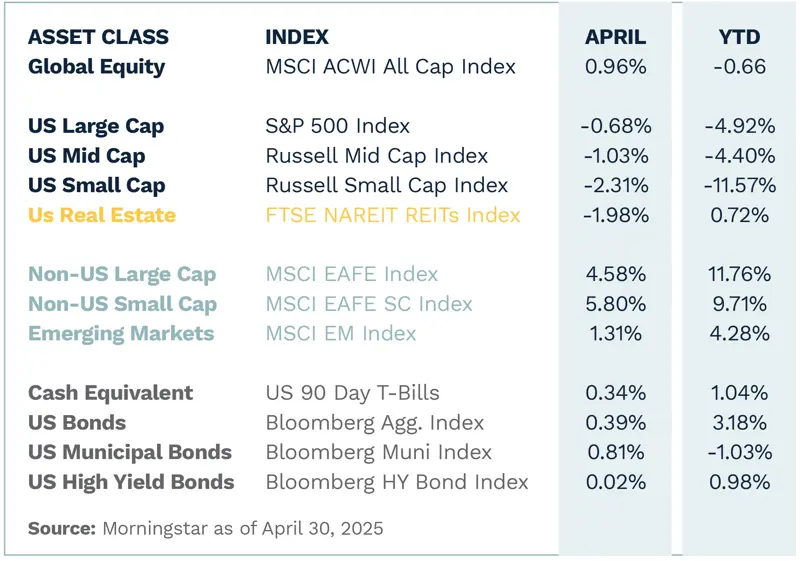
Growth equities outpaced value across market capitalizations, as value-heavy sectors like energy, materials and financials lagged behind growth-oriented sectors such as technology and consumer sectors.
International equities extended their lead, supported by a weaker U.S. dollar and relatively stronger local market performance. Mexico stood out, rising 13%, as tariff attention shifted from North America to other regions.
While headline fixed income returns looked muted on the month, they were anything but beneath the surface. Yields on the long end of the curve spiked mid-month, pressuring bond prices down. Speculation swirled from rising inflation expectations and weak Treasury auction demand, to foreign central bank selling, questions over the U.S. dollar’s reserve status, or even a hedge fund unwinding a position. But by month-end, cooler heads prevailed and the 30-year yield closed almost where it began: 4.66%.
LOOKING AHEAD
Tariffs have commanded much of our mental bandwidth recently, but several other forces remain equally, if not more, critical to market outcomes.
Market Conditions – Current valuations, the trajectory of earnings and current fixed income yields matter greatly to future outcomes. These factors have a far stronger connection to forward returns than trade policy in isolation.
Monetary Policy – The Federal Reserve thus far has shown restraint, keeping policy in a relatively restrictive territory. However, we believe the Fed will act in good faith if clear signs of economic weakness emerge. While timing and magnitude remain uncertain, history suggests the Fed is more likely to support than to stand still if growth falters.
Fiscal Policy – It stands to reason that the receipts collected from tariffs will be used in the political budgetary machine to create equally stimulative fiscal policies such as corporate and personal tax cuts, incentives for domestic manufacturing or infrastructure. While no such details have emerged, if it is indeed “big” or “beautiful” the markets may react favorably.
We believe portfolio positioning coming into the year remains as relevant today as it did then to weather both uncertainty and elevated volatility.