Winter Crosscurrents. Strong global equity markets in February were shrouded by escalating tension in the Middle East.
Market Update
KEY OBSERVATIONS
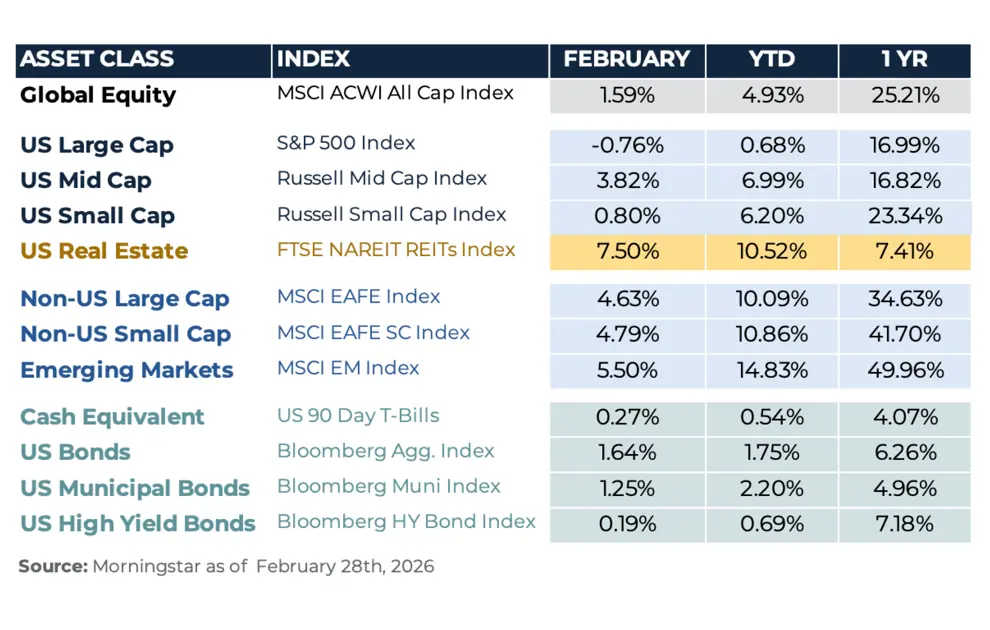
Markets Rally – Global equity markets were positive as cooling inflation hopes clashed with mixed Fed signals and rising geopolitical risk. International equities delivered strong gains, benefiting from the demand for AI related hardware, while U.S. large cap equities slipped on continued concern from AI software disruption.
Supreme Court Issues Ruling – The U.S. Supreme Court struck down the broad tariffs the President imposed under IEEPA. Policy uncertainty remains and the initial market impact was somewhat muted on the announcement.
Geopolitical Tensions Rise – Tensions escalated in the Middle East, culminating with a coordinated military strike on Iran by the U.S. and Israel on the last day of the month. The humanitarian and geopolitical impact overshadows the immediate near-term market impact.
RECAP
February delivered a mix of optimism and unease, as investors grappled with a host of developments throughout the month. Early on, markets took comfort from signs that inflation was cooling as the January CPI report, released in February, came in lower than expected. That helped keep the conversation alive around eventual rate cuts, even as Federal Reserve communications indicated mixed views on the future path of interest rates. Later in the month the U.S. Supreme Court ruled the International Emergency Economic Powers Act (IEEPA) does not authorize the President to impose broad based tariffs. Volatility ticked higher and inflation concerns reignited as geopolitical tensions escalated in the Middle East when the U.S. and Israel mounted a coordinated military strike against Iran on the last day of the month.
Against that backdrop, large-cap U.S. equities finished slightly lower. The S&P 500 Index fell (-0.8%), pressured by continued anxiety around software disruption from AI. Information technology and financials were among the sectors negatively impacted. Sentiment has shifted from the Magnificent 7 to the “HALO” trade (hard-asset, low obsolescence). Investors favored areas of the market perceived to be more insulated and less susceptible to direct disruption from AI. Asset-heavy sectors such as utilities, energy, materials, and industrials were top performers. Small caps held up better, with the Russell 2000 Index producing a slight positive return (+0.80%), a reminder that market leadership broadened beyond mega‑cap growth as investors leaned into more cyclical and value‑oriented areas.
Outside the U.S., returns were notably stronger. Non-U.S. developed markets, as measured by the MSCI EAFE Index, gained 4.6%, while emerging markets, as measured by the MSCI EM Index, rose 5.5%. Part of that strength reflected a market narrative that emerging market exposure to the “hardware side” of AI, especially in parts of Asia, looked more durable than stretched U.S. software valuations. Japan was a standout for developed markets as investors viewed the election outcome favorably due to expectations of increased government spending. In Europe, easing inflation pressures and strengthening economic data helped propel markets.
Fixed income markets offered welcome ballast. Core fixed income, as measured by the Bloomberg U.S. Aggregate Bond Index, returned 1.6%, supported by a meaningful rally in Treasuries during the month as longer‑term yields moved lower. High yield lagged, but still finished modestly positive, up 0.2%, as carry remained supportive even with pockets of risk aversion near month‑end. Real assets were a bright spot. REITs surged 7.5%, benefiting from falling long‑end yields and improving sentiment toward rate‑sensitive income sectors. Commodities gained 1.1%, supported by firming inflation expectations at the end of the month as U.S.-Iran tensions grew.
Operation Epic Fury
On February 28th, U.S. and Israeli forces launched coordinated military strikes on Iran, targeting nuclear facilities, military infrastructure and senior leadership. Iran's Supreme Leader, Ali Khamenei, was killed, and retaliatory strikes have since begun. The situation remains fluid.
Military action that results in civilian death and displacement is, of course, a grave humanitarian tragedy. We hope for a swift resolution. Turning to our investment remit, the financial market impact of such events often proves far less severe than the human toll, and where material, tends to be concentrated in specific markets and economic sectors. In the Middle East, that nexus is energy production and its transit. Below, we examine the scale of the potential impact and, most importantly, answer the question: how does this affect your portfolio?
Economic Fall Out
A complete accounting is not yet possible while military action remains kinetic, but we can begin to frame for context. The immediately affected region represents approximately 2.6% of global GDP, with Iran accounting for approximately 0.4% on its own. Importantly, even during active conflict, commerce does not halt entirely. It slows but continues. Assuming a 50% decline in Iran's GDP and a 10% decline across the broader region, the drag on global GDP would be approximately 0.4%, roughly equivalent to five days of U.S. economic output. Significant for those within the region, but not at a scale that alters global economic trajectory.
Collateral Damage
The impact, however, does not stop at regional borders. Energy is the most consequential export at risk. The Middle East accounted for approximately 30% of global oil production and 17% of global natural gas production in 2024. Material disruption to these facilities would place upward pressure on headline inflation. The more likely friction point, though, is not at the well or refinery. It is in transit. The Strait of Hormuz, a 21-mile passage, is one of the world's most critical chokepoints for seaborne energy. In 2024, flows through the Strait accounted for more than one-quarter of total global seaborne oil trade and approximately 20% of global oil and petroleum product consumption. Separately, approximately 20% of global liquid natural gas (“LNG”) trade also transited the Strait in 2024, primarily from Qatar.
That flow, however, is not distributed evenly across the globe. Roughly 84% of crude oil and LNG volumes moving through the Strait are destined for Asia, with China, India, Japan and South Korea as the dominant oil importers and, to a lesser extent, Asia also absorbing the bulk of LNG flows. Europe is a secondary recipient of natural gas. The U.S. has limited direct exposure, given its status as a net commodity exporter. Even so, oil is priced globally, and rising prices would affect U.S. producers and consumers alike.
Market Impact
History, unfortunately, offers no shortage of data points on how markets respond to military conflict. The pattern is consistent: when conflict remains regionalized, the market impact tends to be transitory. Initial reactions are typically negative, as uncertainty drives investors toward safe havens such as bonds and the U.S. dollar.
With limited public appetite for a sustained U.S. military engagement in Iran, and the risk that prolonged conflict could lift headline inflation ahead of an affordability-focused midterm election later this year, we expect either resolution or meaningful de-escalation in the near term. The larger puzzle pieces on the board are connecting the events in Iran with developments in Venezuela, pressure on Cuba and Greenland, and the evolving arc of U.S.-China relations. President Trump and Xi are scheduled to meet in a number of weeks to discuss evolving relations. Given the transitory and regionalized nature we described above, we believe portfolios are well positioned to navigate near-term volatility. We will continue to monitor and should the situation evolve meaningfully we will follow up with the potential impact.