Rising Rates, Resilient Growth. Markets weakened as bond yields surged, but earnings outlook remains intact.
KEY OBSERVATIONS
Broad market weakness – September brought broad weakness across financial markets as persistent inflation, the war in Iran, and the Federal Reserve's 25-basis-point rate hike drove Treasury yields sharply higher and pressured both stocks and bonds.
AI capex boom – The AI capital-spending cycle remains a meaningful source of economic and earnings momentum, but depleted free cash flow is pushing more companies toward debt financing and increasing scrutiny of leverage, borrowing costs, and the durability of future returns.
Fed policy challenge – The Fed faces an unusually difficult policy backdrop: AI infrastructure spending may remain relatively insensitive to modest changes in borrowing costs, while geopolitical instability and higher energy prices are adding inflationary pressure that tighter financial conditions cannot directly resolve.
RECAP
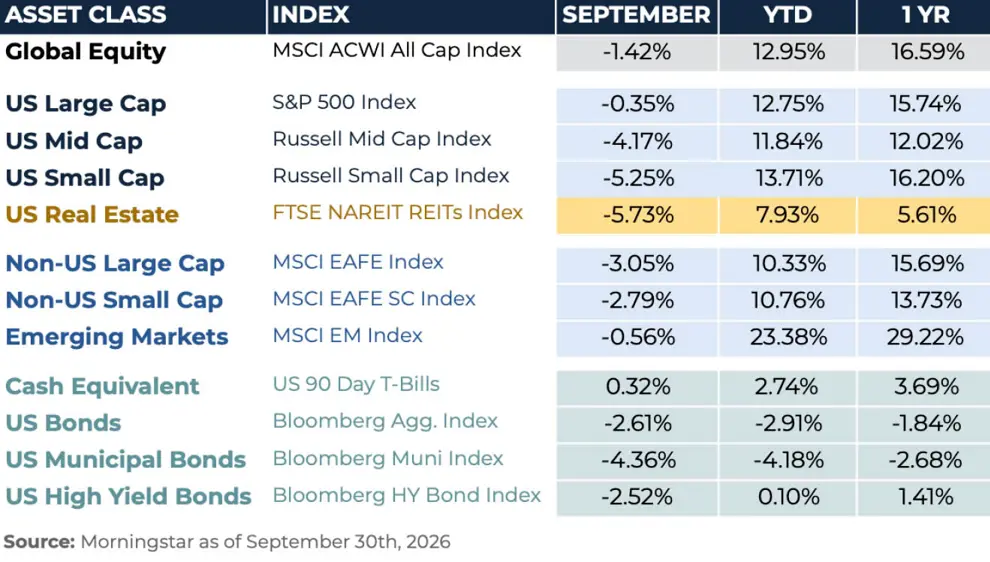
September was marked by broad weakness across financial markets as investors continued to contend with a sell-off in bonds, lingering uncertainty surrounding inflation, and the ongoing war in Iran. As expected, the Federal Reserve moved forward with a 25 basis points rate hike and signaled that additional hikes may be necessary to contend with a recent resurgence of inflationary pressure. Bond yields surged throughout the month, with the benchmark 10-year Treasury yield rising by over 50bps and ending the month just below 5.30%, a level not seen since 2007. With financing costs moving starkly higher and geopolitical uncertainty remaining elevated, most major equity and fixed income benchmarks shed value during September. Tightening financial conditions were a drag on listed real estate performance, as the FTSE NAREIT All Equity REITs Index fell 5.7%, though it remained up 7.9% year-to-date.
U.S. equities were mixed but generally softer. The S&P 500 declined 0.3%, though the index remained up 12.7% year-to-date. Smaller companies – which tend to carry more leverage and are thus more impacted by rising interest rates – experienced larger losses, with the Russell 2000 falling 5.3% during the month. Even after the decline, small caps retained their advantage over large caps, ending the month with a 13.7% year-to-date gain.
International markets also moved lower. The MSCI EAFE Index returned -3.1% in September, reducing its year-to-date advance to 10.3%. Emerging markets proved more resilient, with the MSCI Emerging Markets Index declining by a more modest 0.6%. Emerging Markets remain the strongest equity performer for the year, up 23.4% through September.
Fixed income came under pressure during the month as markets firmly priced in a Fed hiking cycle and began demanding a meaningfully larger term premium. The Bloomberg U.S. Aggregate Bond Index fell 2.6% and has now returned -2.9% for the year. Credit did not fare much better, as high yield bonds declined 2.5%, though the Bloomberg U.S. Corporate High Yield Index held onto a slight 0.1% year-to-date.
OUTLOOK
The remainder of 2026 will bring multiple challenges for markets. The Fed will meet two more times before the calendar rolls over, and current market pricing suggests at least one more hike is still to come. The Fed remains in a difficult position, as the economy is being influenced by forces that sit somewhat outside the traditional framework of monetary policy. The secular AI infrastructure buildout continues to drive substantial capital expenditures across the technology ecosystem, providing a source of economic momentum that may be relatively insensitive to modest changes in borrowing costs. Simultaneously, geopolitical instability and higher energy prices are creating inflationary pressures that cannot be easily addressed through tighter financial conditions.
November’s midterm elections also present uncertainty that markets must contend with. Republicans are clinging to a small majority in the House and Senate, but risk losing control of both. History suggests that the president’s party tends to lose ground during mid-term election cycles, and prediction markets are currently suggesting that this cycle will not differ from the norm. The good news for investors is that markets tend to perform well after the conclusion of the midterm elections, bolstered by the clarity that follows. More importantly, the factors that ultimately drive long-term market returns remain intact. The economy continues to expand, employment conditions remain healthy, and corporate earnings growth continues to exceed expectations in many sectors. While the path forward is unlikely to be free of volatility, we continue to see reasons for cautious optimism as we enter the fourth quarter.